
Scientific Trace: Making Scientific Judgments Traceable in a Self-Evolving Laboratory
TECHNICAL REPORT · SCIENTIFIC TRACE
Research agents can already search the literature, call tools, and generate research recommendations. Yet when presented with a specific conclusion, biologists still need to ask: What inputs and conditions underpin it? Which calculations or experiments have validated it? The answers determine whether a recommendation is ready for the next experiment and whether unexpected results can be traced back to the steps that need to be reexamined. This article introduces SE-Fab's Scientific Trace, a feature that helps biologists and agents trace execution evidence and review key judgments, making scientific judgments traceable in a self-evolving laboratory.
Scientific Trace links key judgments to input data, tool calls, evidence artifacts, and human review records. It helps biologists and agents trace conclusions back to their supporting evidence, check conditions of applicability, and identify evidence gaps. Successful results are saved together with the conditions under which they apply; failures leave a record for investigation; and revisions to judgments retain the rationale behind each change. These records can be archived and exported with the task, allowing different biologists and agents to review the evidence, hand over work, and document lessons learned. They provide a basis for improving subsequent experimental designs, assessment criteria, and research strategies.
Beginning with a polymerase mutation case study, this article explains why scientific judgments need to be linked to evidence and the conditions under which they apply. It then introduces Scientific Trace's recording mechanisms and review workflow. An actual enzyme-screening task and a demonstration of an external model reading an Evidence Bundle show how these records help trace execution, examine the basis for conclusions, and clarify which forms of verification these records can support.
00 / Problems in Real-World Research
A Quick Look vs. an Evidence Chain
An experienced biologist needs only a few seconds to interpret a gel electrophoresis image: band positions provide an initial indication of whether amplification products of the expected size are present, while unexpected bands offer clues that warrant further investigation, such as nonspecific amplification or primer dimers. Through thousands of failed experiments and accumulated experience at the bench, this process of “look once, make a judgment” has become part of the biologist's internal model of the physical world.
When a model takes part in more complex molecular design tasks, the basis for its judgments needs to be recorded explicitly. Consider a hypothetical scenario: a user enters the sequence of a thermostable DNA polymerase, and the model promptly returns a design suggestion: “Recommended mutation: T375A; predicted change in DNA-binding free energy relative to the wild type: -2.3 kcal/mol; reference: PMID: 31245678.”
On screen, this statement looks polished and confident. In life science R&D, however, a biologist needs to investigate several key questions:
- Has the residue numbering shifted in the multiple sequence alignment (MSA)?
- Was the free-energy value actually calculated using Rosetta, or did the model invent it through probabilistic text generation?
- Does the cited publication actually exist in PubMed?
- Which versions of the sequence and structure were used in the calculation? Were any data truncated along the way?
In software, many failed calls can be retried quickly. In a life science laboratory, plasmid construction, primer synthesis, protein expression in cells, and enzyme activity assays take days or even weeks. A pack of high-fidelity DNA polymerase reagents, together with other reagents consumed, can cost thousands to tens of thousands of yuan. Before committing experimental resources, biologists need to understand the evidence behind a recommendation, the conditions under which it applies, and how it will be validated. Delivering this information alongside the proposal helps them direct resources toward a next step grounded in evidence.
An experienced biologist's rapid judgment rests on experience and experimental evidence that can be examined; an agent's recommendation likewise needs a basis that can be questioned and verified. Verifiable inputs, actual tool calls, artifact snapshots that can be checked against recorded hashes, and independent review allow biologists to examine both the basis for a judgment and the scope of its applicability.
Case Study: Evaluating a Polymerase Mutation Recommendation Against the Evidence
Expand case study: Why the same mutation produces different results in different sequence backgrounds
When engineering a DNA polymerase for sequencing applications, biologists need to consider its ability to incorporate modified nucleotides, whether its performance is balanced across all four substrates, and whether its interactions with DNA suit the sequencing workflow. Here, the single-site change under investigation is designated mutation A, and the engineered parent BP0 serves as the activity reference. The site affected by mutation A warrants investigation: archived structural analysis places it near the DNA-contact region and outside the catalytic pocket. This structural clue helped biologists identify an engineering strategy worth testing experimentally.
Based on this structural information alone, a large language model could easily offer a plausible recommendation: “Prioritize peripheral DNA-contact sites to adjust interactions with DNA while preserving catalytic function.” Activity measurements, however, revealed a condition that this statement omitted. Introducing mutation A alone into BP0 retained approximately 97.3% of BP0's activity. Introducing it into a variant whose existing combination of mutations had already increased activity reduced activity from approximately 2.41 times to 1.89 times that of BP0, a drop of about 21.6% relative to the variant before mutation A was introduced. A mutation with little effect in one sequence background may impose a substantial activity cost in another. These results show that mutation effects must be interpreted in the context of the specific sequence background and assay conditions, with structural clues and experimental findings considered together.
Faced with such a recommendation, biologists need to follow the evidence and ask further questions:
- Which versions of the sequence and structure do the residue numbers refer to? Does the current design retain BP0's existing engineered background? Which model and distance calculations support the judgment that the site is “close to DNA and outside the catalytic pocket”? Can the original analysis be retrieved?
- In which mutational background and under which assay conditions was “97.3% activity retained” measured? Does the new task require an assessment of modified-nucleotide incorporation activity or of DNA retention? Can the existing activity result be used directly to assess a new combination?
- How should the original recommendation change when new results arrive? Which judgments still hold, and which require additional experiments?
Carrying recommendations, evidence, applicable conditions, and questions that still require validation into the next experiment makes it possible to understand why a design works and how it should be adjusted.
This is why SE-Fab maintains an execution evidence chain: it records input sequences, structural analyses, tool outputs, and variant identities together, explicitly distinguishing facts, inferences, and recommendations. When new evidence changes a judgment, it preserves the original record and explains why the judgment was revised, which questions remain, and what needs to be validated next. Biologists can trace how a recommendation arose and understand why it was retained, adjusted, or rejected, putting the evidence accumulated in each experimental round to use in the next round of design.
01 / Collaboration: Shared Requirements from Biologists and AI Engineers
As agents move toward the laboratory bench, they first need to address the different expectations that two roles have of task deliverables:
Biologist: “I don't care how many parameters the model behind the screen has, or how fluent its output is. I need to know: Which steps in this proposal involved actual calculations, and which were guesses? Were the underlying data truncated? If it fails at the bench next week, can I follow the records to find exactly which step went wrong?”
AI engineer: “Life science workflows are extremely long, often involving dozens of specialized bioinformatics tools and external databases, with randomness accompanying each model call. I want to examine whether the agent's judgments have a verifiable basis, just as I inspect call chains in software systems. I want every conclusion to point to concrete evidence, rather than having every disappointing result attributed to ‘model hallucination’ in the AI system as a whole.”
Scientific Trace needs to address both demands: enabling AI engineers to deliver inferences supported by verifiable evidence, allowing biologists to review an agent's execution process as they would a peer's paper, and making review comments a shared basis for advancing the next task.
The ultimate goal of automation is not simply to press Enter on a human's behalf. It is to turn the output of uncertain, probabilistic generation into scientific evidence that can be found, understood, verified, reviewed, and reused.
02 / Background: How a Self-Evolving Laboratory Links Judgments to Execution Records
Judgments in research tasks draw primarily on three sources: models and software calculations, experiments and instrument operation, and experience and expert judgment. Scientific Trace links these judgments to their supporting evidence:
- Models and software calculations: preserve input versions, computational conditions, tool calls, and artifacts so conclusions can be traced to their basis (established).
- Experiments and instrument operation: record the design rationale before an experiment is submitted and link it to subsequent execution and measurement feedback (instrument record integration is in progress).
- Experience and expert judgment: preserve key decisions by biologists and experts, the agent's choices between approaches, and the Reviewer's comments, showing who changed a proposal and on what basis (established).
SE-Fab is building Scientific Trace to make evidence tracing practical in specific research tasks. It organizes input versions, computational and experimental conditions, the rationale behind judgments, and human–AI decisions, linking research choices to execution records in an archive that can be consulted and reviewed. Existing research on observability, provenance, and experimental orchestration provides a foundation for organizing SE-Fab's task workflows and evidence.
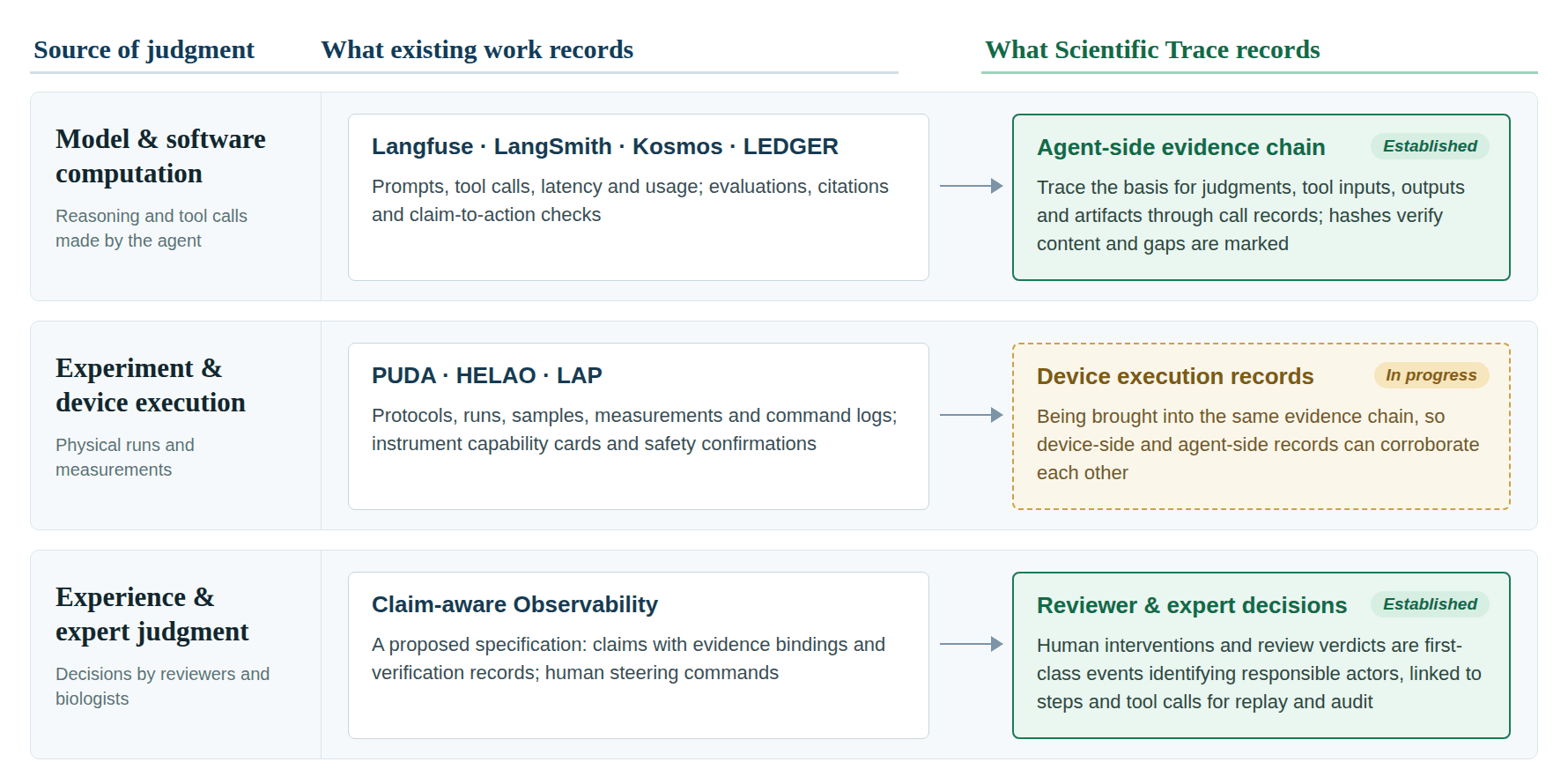
Existing approaches to recording three types of decisions, and the scope of Scientific Trace
Related Research and Design Tradeoffs
| Source of judgment | Reference approaches | Focus of existing work | Scientific Trace's design and research value |
|---|---|---|---|
| Models and software calculations | Langfuse, LangSmith[1][2]; Kosmos, LEDGER[3][4] | Record calls, performance, and usage, and link report conclusions to code, literature, supporting actions, or artifacts so the source of a result can be traced | Organize computational conditions and evidence around conclusions: archive input versions, alignment thresholds, reference databases, and tool environments alongside call records, and link judgments to their supporting evidence through steps, call identifiers, and evidence references; artifacts are saved by content hash. Biologists can locate the conditions on which a judgment depends, decide whether the result applies to the current task, and identify steps that need revalidation (established) |
| Experiments and instrument operation | PUDA, HELAO, LAP[5][6][7]; SAMPLE[8] | Organize experimental execution and data provenance around protocols, runs, samples, and measurements to support instrument coordination; some also include autonomous planning and experimental feedback | Connect the rationale for experimental choices to execution feedback: record the agent's design judgments and the supporting tool results and literature evidence before submitting an experiment, then link instrument records through run identifiers, timing information, and artifacts. Tracing an anomaly through the design, parameters, and execution conditions helps distinguish a proposal that needs revision from an execution deviation that needs investigation (instrument integration in progress) |
| Experience and expert judgment | Claim-aware Observability, PROV-AGENT[9][10] | Include scientific conclusions, evidence bindings, and human adjustments in observability or provenance models, also covering auditable objects such as instrument files and operator approvals | Preserve decision rationale for the next collaborator: record interventions by biologists, model choices, and Reviewer verdicts as first-class events that identify the responsible actors and link to the relevant steps and evidence. This supports replay and attribution of responsibility, helping subsequent biologists and agents understand why a proposal was accepted, modified, or rejected, and providing a basis for distilling lessons learned and improving assessment criteria (established) |
Models and Software Calculations: From the Source of a Result to the Conditions Behind a Judgment
Call tracing and conclusion provenance already make prompts, tool calls, code, and literature citations traceable. The platforms and systems above provide foundations for recording calls and tracing conclusions to their sources. OpenTelemetry GenAI[11] and Workflow Run RO-Crate[12] further provide tracing semantics and formats for exchanging workflow run records, enabling different systems to organize and exchange execution records.
For SE-Fab's life science tasks, we preserve the computational conditions under which a result holds alongside its execution records. For example, when a sequence alignment identifies candidate sequences, biologists need to know which input version was used, whether truncation occurred, how thresholds were set, and whether the reference database is appropriate for the current research context. These conditions explain why the candidates were selected and determine how the result can be used after the database or task context changes.
Scientific Trace therefore organizes records around “conclusion—conditions—evidence”: computational conditions are saved with call records; steps, call identifiers, and evidence references connect judgments to their supporting evidence; artifacts are saved by content hash; and the Reviewer follows these links to examine how well the evidence supports the conclusions. Biologists receive both the source of a result and the information needed to decide whether it applies, how to review it, and when it needs to be revalidated. Events are recorded continuously throughout the task, with subsequent explanations and revisions retained in the same archive so that the evidence behind both the original and revised judgments can be revisited.
Experiments and Instrument Operation: Connecting “Why We Did It” with “What Actually Happened”
Existing work on instruments and experiments focuses on reliable instrument control, experimental orchestration, and the provenance of run data. Relevant approaches include PUDA, HELAO, LAP, and SAMPLE[5][6][7][8]. These efforts make it possible to record the links between protocols, runs, samples, and results; some also include autonomous planning and experimental feedback.
In SE-Fab, this chain must also capture the design rationale derived from bioinformatics tools, literature, and biologists' judgments. Why prioritize testing this combination of mutations? Which calculation supports it? Why did the biologist adjust the reaction conditions? Answering these questions requires linking the rationale for choices made before an experiment is submitted to subsequent execution results. This helps determine whether a failure calls for a design revision or an investigation of samples and execution conditions first.
Scientific Trace records the agent's design judgments, tool results, and biologists' comments before an experiment is submitted, creating a record of the rationale that can be revisited. As instrument records are integrated, run identifiers, timing information, and related artifacts link execution feedback to this record. This design brings experimental choices, parameter tradeoffs, and execution feedback together for review, preserving clues from anomalies to inform the next round of troubleshooting and design.
Experience and Expert Judgment: Making Decision Rationale Transferable and Reusable
Claim-aware Observability and PROV-AGENT[9][10] already incorporate conclusions, evidence relationships, and human adjustments into general observability or provenance models, preserving records of human–AI collaboration. Research tasks raise further questions: Which problem did an adjustment address? What evidence supported it? Why was the original proposal accepted, modified, or rejected?
Scientific Trace saves interventions by biologists, the model's choices between approaches, and the Reviewer's verdicts as first-class events that identify the responsible actors and link to relevant steps, tool calls, and evidence. Both generation and review must be grounded in evidence. The rationale behind a recommendation, a biologist's reasons for adjusting it, and the Reviewer's objections can therefore be compared within a single task archive rather than being scattered across separate conversations.
Preserving these reasons allows subsequent collaborators to understand existing choices and assess which lessons apply to a new task. The independent Reviewer's comments are exported with the Evidence Bundle. Biologists and new agents can use them to continue checking the evidence, distill lessons learned, and refine assessment criteria, turning human judgment and model exploration into research assets that accumulate over time.
We organize records around scientific judgments so biologists can examine how a task was executed and review the evidence and conditions on which its conclusions depend.
03 / Design Philosophy
Scientific Trace organizes task records around four requirements, helping biologists check execution, review judgments, and continue using these records in subsequent research:
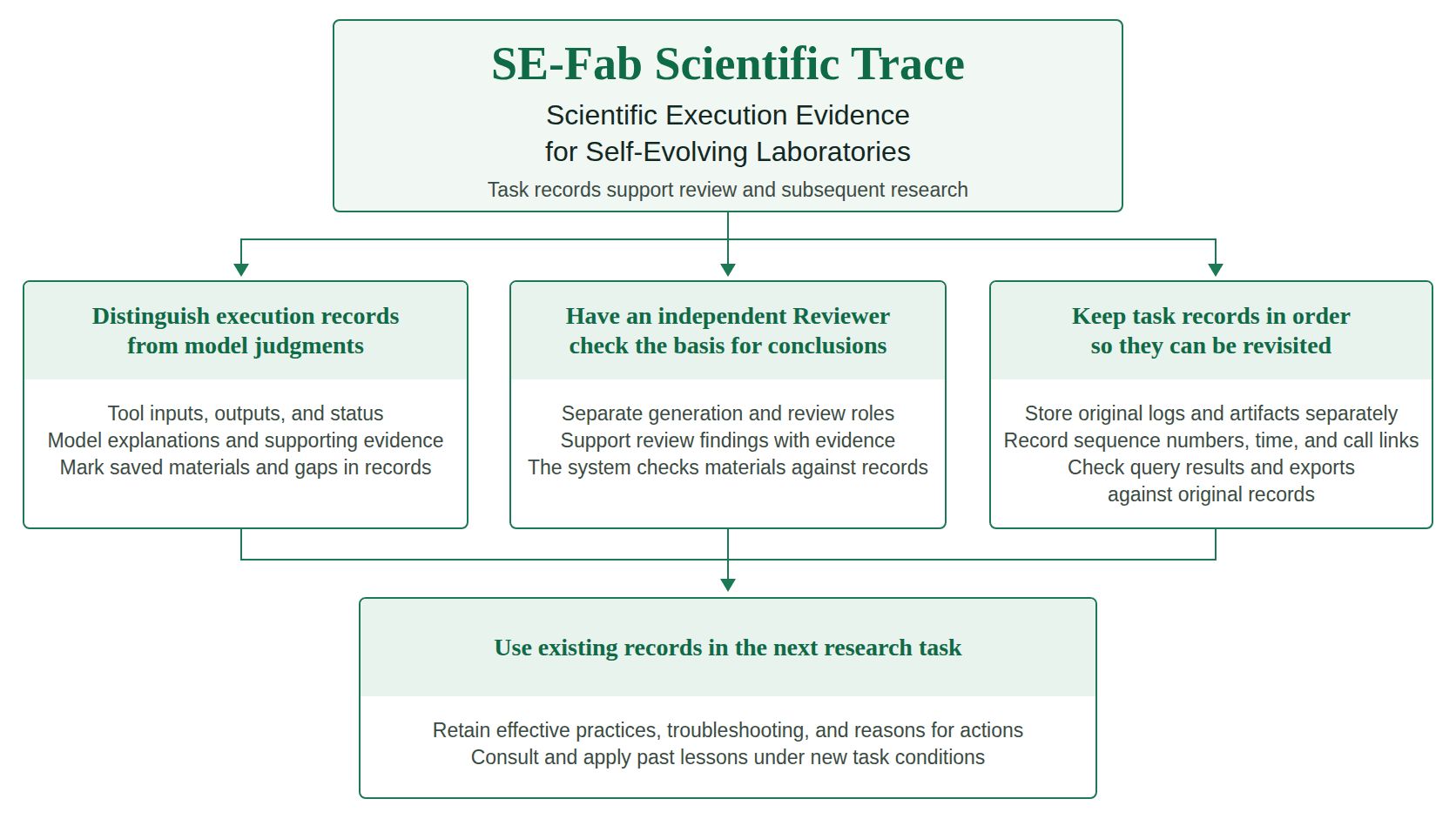
Distinguish Execution Records from Model Judgments
What a tool actually received and returned should be recorded separately from the model's interpretation of the result. Scientific Trace retains both types of information so biologists can compare judgments with what actually happened during execution.
- Execution facts capture the inputs that tools actually received, their outputs, execution status, and duration, together with content hashes for the resulting artifacts.
- Scientific judgments capture the model's interpretations and hypotheses, along with the publications and artifacts supporting them, for review by the Reviewer.
- When a judgment changes, the original execution records are retained. The records also indicate whether supporting materials have been saved and which records are missing, making subsequent verification easier.
Have an Independent Reviewer Examine the Evidence Behind Conclusions
Different roles are responsible for proposing an approach and reviewing the evidence, ensuring that conclusions receive an independent check.
- The main agent and subagents plan and advance the task, handling specific work such as calculations and literature review.
- An independent Reviewer checks whether the evidence supports the conclusions and explains any issues identified and the evidence behind them. The system automatically checks record structure and the completeness of supporting materials. Review comments are saved with the task, and biologists resolve significant disagreements.
- Both generation and review must explain the basis for their judgments. The agent records its rationale, while the Reviewer explains the evidence behind each issue and provides the relevant artifact or call identifier for findings marked as failures. Questions that can be checked directly, such as whether a file exists, are converted into structured factual assertions and checked against saved records. If an objection conflicts with those records, the system corrects the corresponding finding and preserves the evidence for the correction.
Save Task Records in Sequence for Review at Any Time
The steps a task went through and the results of each step should be retrievable from the original records. Scientific Trace saves task records in sequence and preserves the links between records and artifacts.
- Records of each task's execution are appended in sequence. Original artifacts are saved separately by content hash, with their references and storage status retained in the records.
- Sequence numbers, timestamps, and relationships between calls help reconstruct the execution order. Concurrent writes are coordinated to prevent sequence conflicts.
- Query indexes are generated from the original log and can be rebuilt. Exports preserve the original event records and saved artifacts, with artifact hashes checked against the evidence manifest. This allows collaborators to verify the materials against the original records when reviewing or handing over work.
Use Existing Records in the Next Research Task
Scientific Trace preserves task execution records and review comments in traceable archives, retaining effective practices, troubleshooting steps, and the rationale for resolving issues. Biologists and agents can revisit how a choice was made or a problem was resolved, then assess which lessons apply under the current task conditions.
Together with the agent's memory mechanism, relevant background and existing records can be incorporated into the context of a new task. This helps subsequent tasks build on earlier research and provides a basis for adjusting experimental designs and assessment criteria.
04 / Core Design: The Task Workflow from Intent to Evidence
Scientific Trace organizes a task's inputs, tool calls, artifacts, and review records into an Evidence Bundle that can be exported as a single package and verified offline.
Interaction Flow: Seven Linked Stages from Intent to Evidence
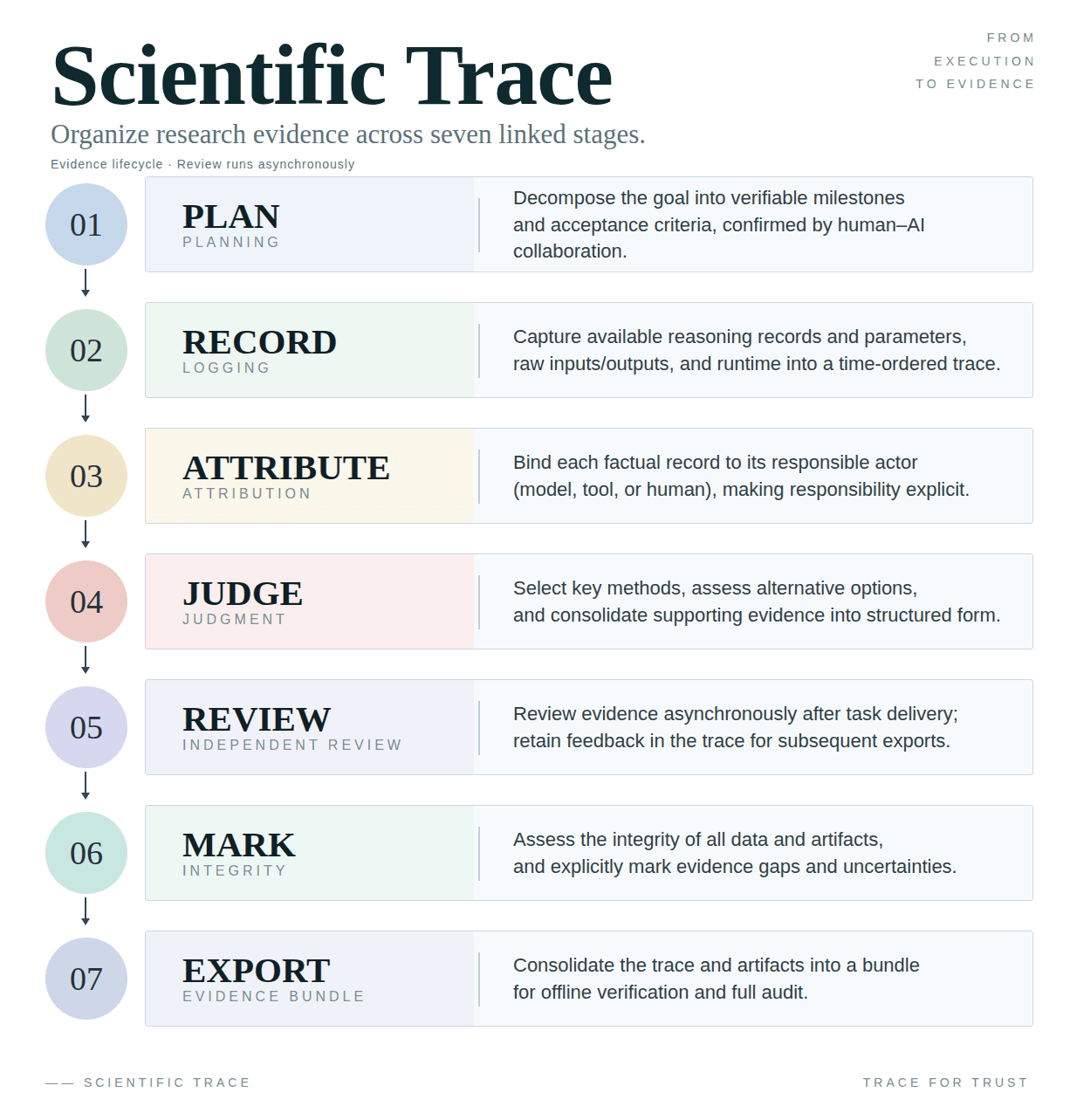
The seven linked stages bring planning, recording, attribution, judgment, review, completeness marking, and export into a single evidence chain. ATTRIBUTE identifies the actors responsible for steps and decisions, while REVIEW examines whether the evidence supports a conclusion. The Reviewer conducts an asynchronous review after task delivery. Its comments are appended to the task archive for biologists to consult and are included in subsequent exports. Biologists can see how the task progressed and trace the evidence behind its results and the review comments.
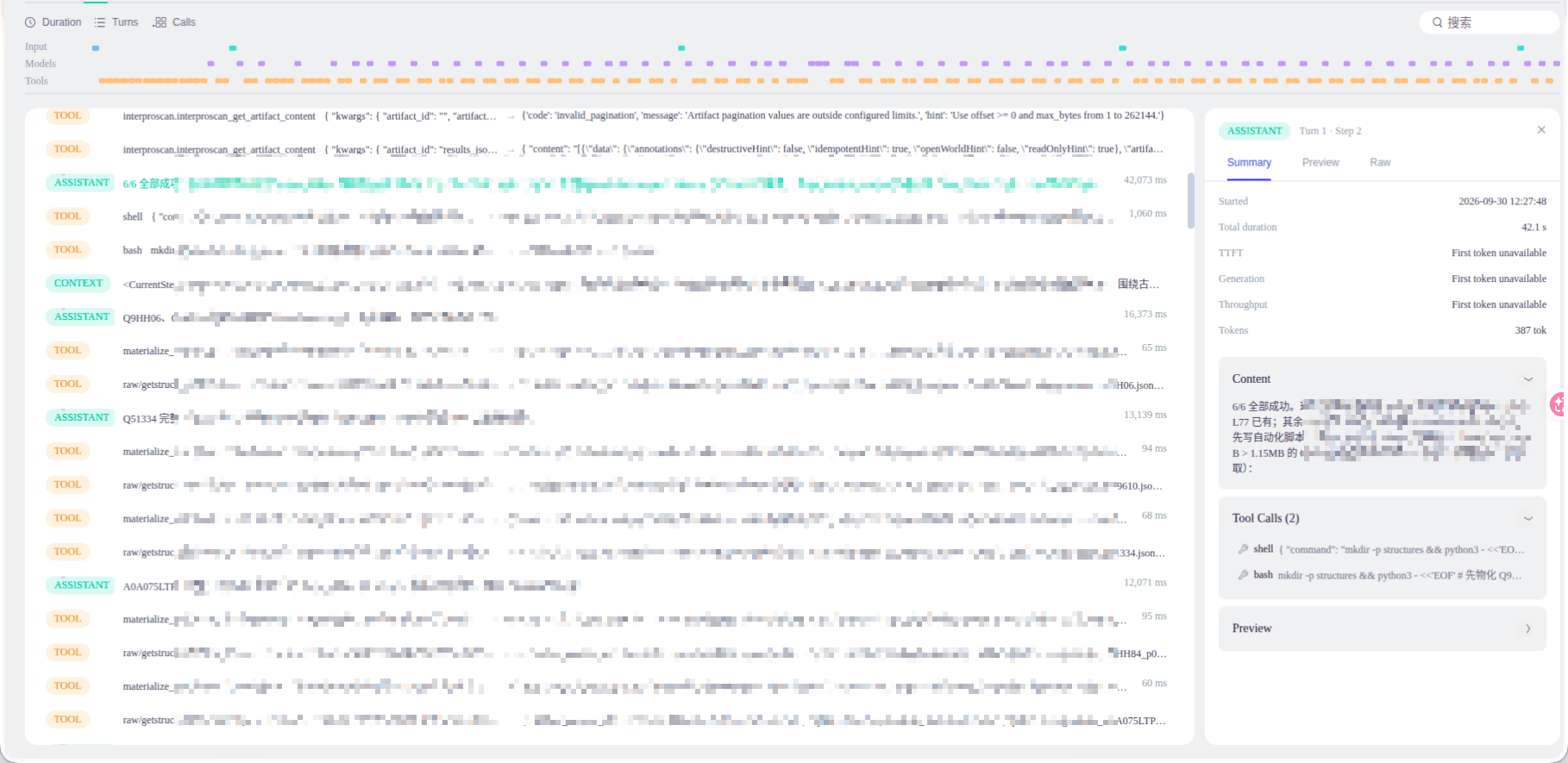
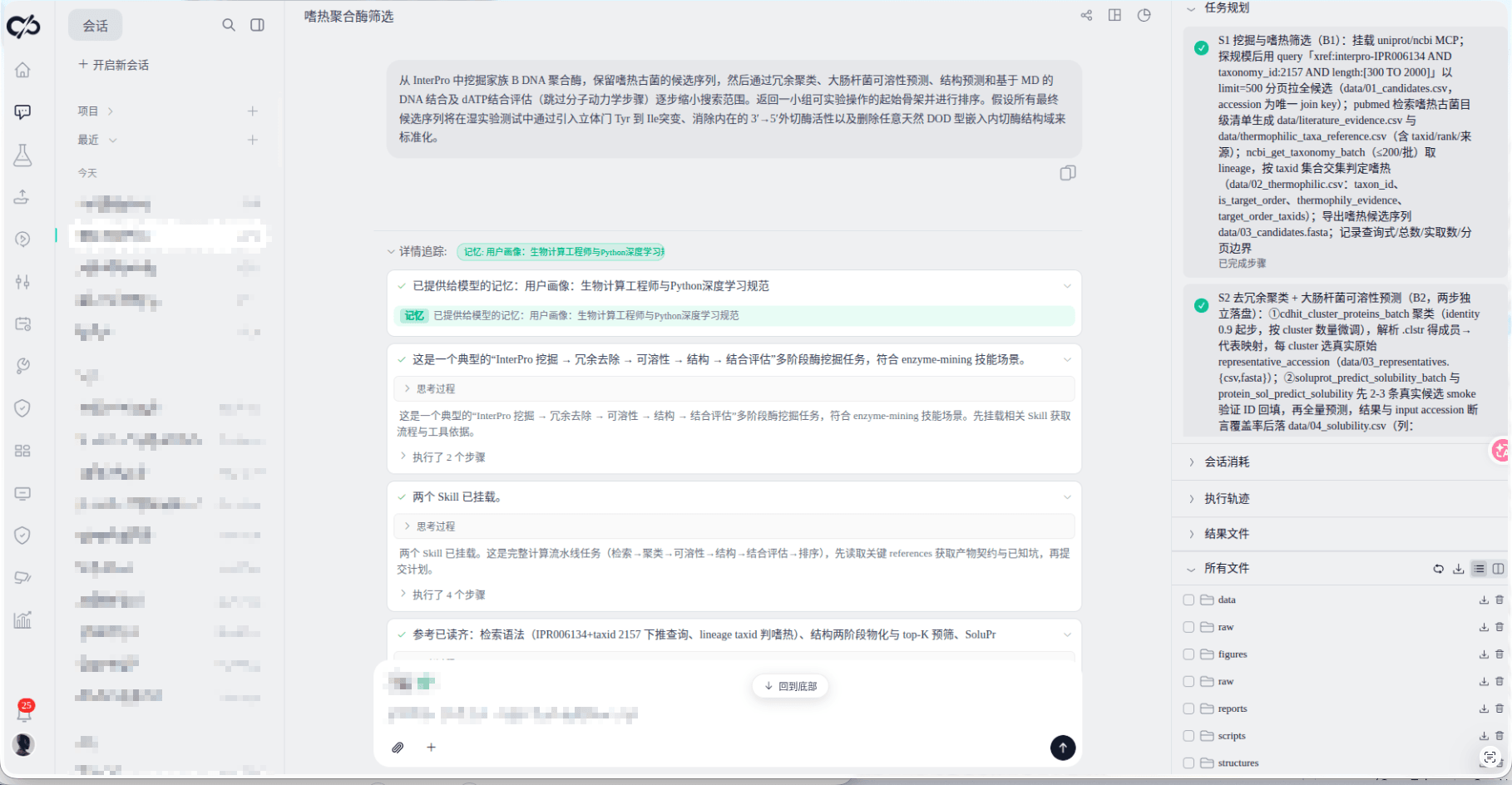
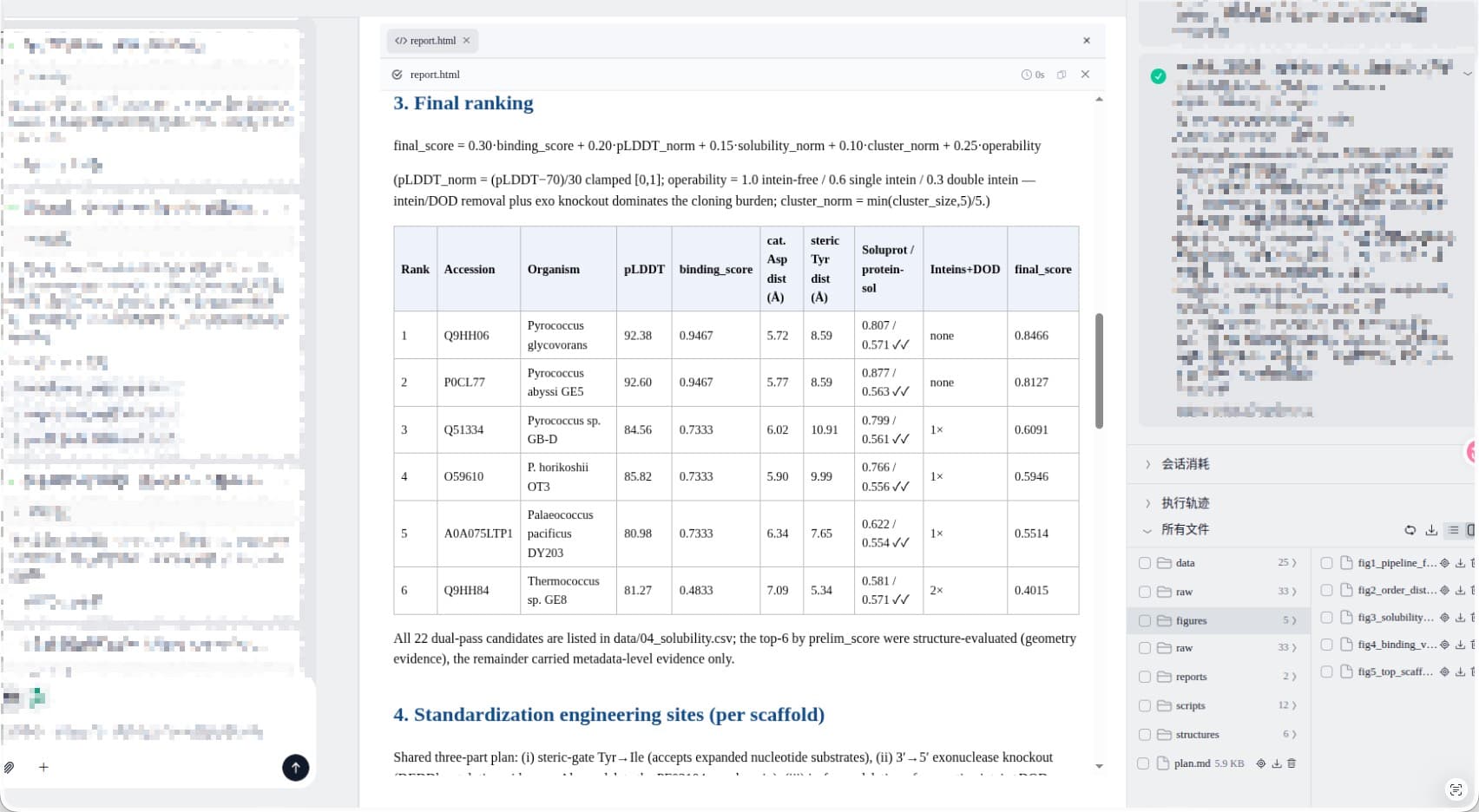
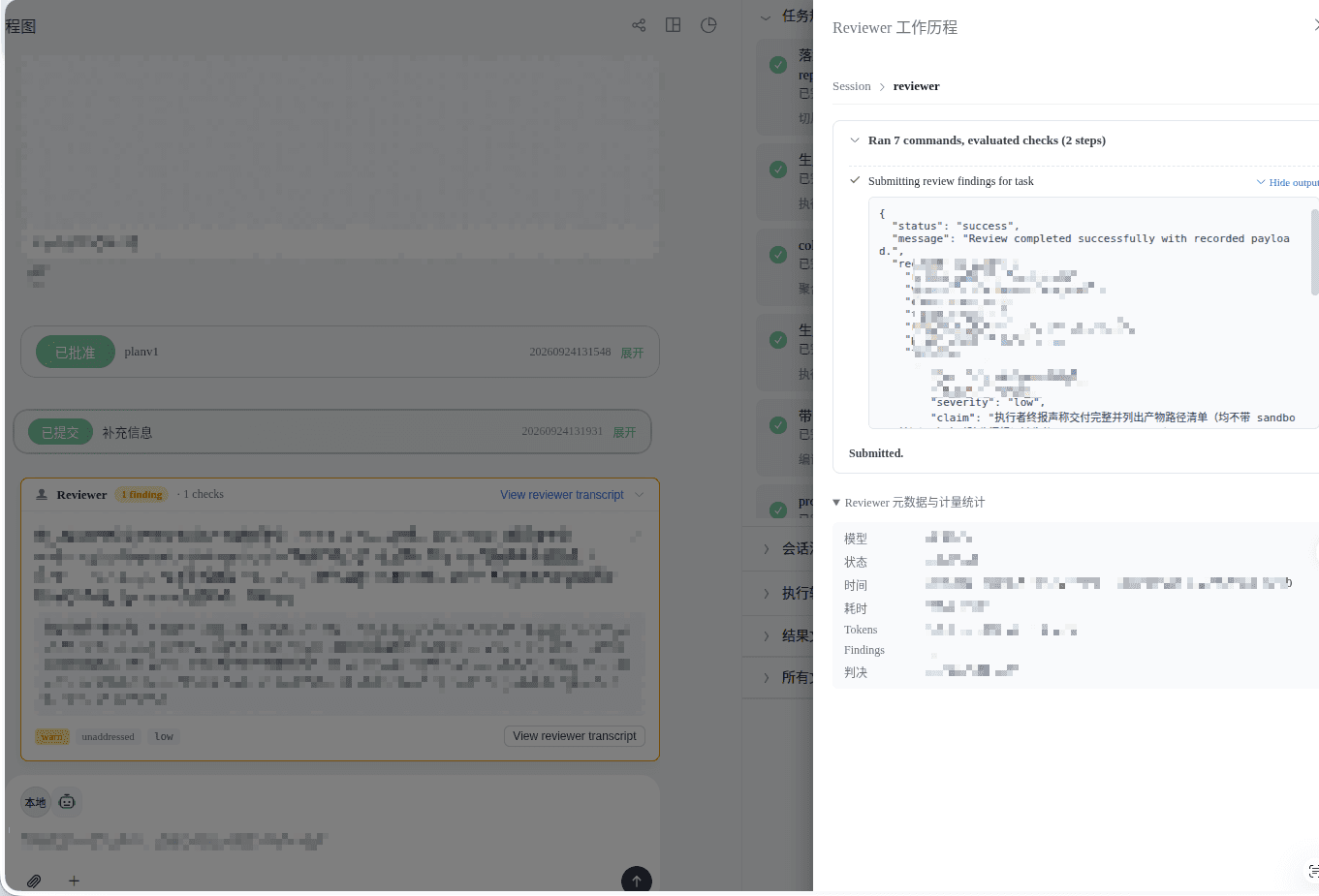
05 / Real-World Case: A Third-Party Large Language Model Reads a 39 MB Evidence Bundle
We used an actual task to demonstrate how Scientific Trace supports external access to task records and the handover of work. We exported the Evidence Bundle from a task to “screen family B DNA polymerases (PolB) from thermophilic archaea” and uploaded the resulting compressed archive, approximately 39 MB in size, to a third-party large language model. We provided no additional project context and asked only: “What is inside this compressed archive?” After approximately 1 minute and 16 seconds of reasoning, the model returned the answer shown in Figure 5.
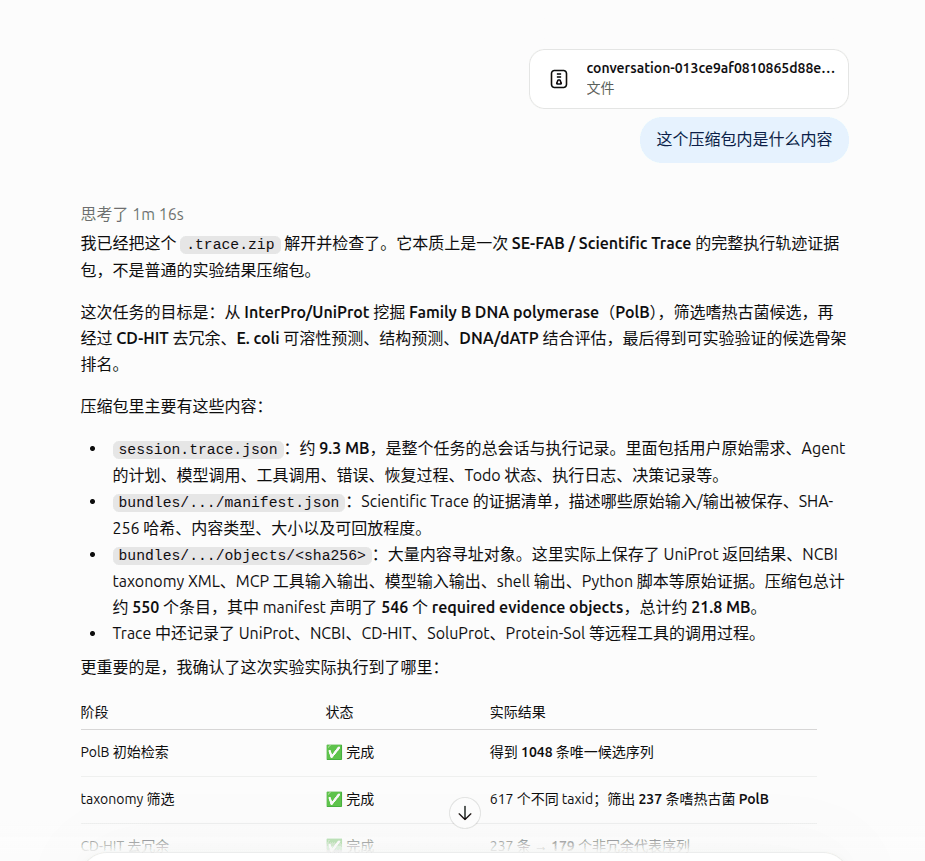
Figure 5 · A third-party large language model parses the Evidence Bundle: it describes the archive as a “complete execution trace evidence bundle,” lists the session records, evidence manifest, and content-addressed objects, and identifies the execution progress documented in the task records
This demonstration shows that an external model can identify the task goal, plan, and some execution results from the exported records without additional project context. It demonstrated the ability to read and interpret the Evidence Bundle; it did not include rerunning calculations or reproducing experiments.
06 / Evidence Maturity: From Process Visibility to a Reviewable Evidence Chain
Scientific Trace supports research collaboration at successive levels: viewing task execution, checking the evidence behind conclusions, handing over work offline, and reusing lessons learned. An orderly process, accessible evidence, and clearly attributed decisions allow biologists and agents to continue working from the same task archive.
SE-Fab uses the following four-level framework to describe its own capabilities:
| Level | Core capability | Assessment and verification | SE-Fab's current status |
|---|---|---|---|
| L1 · Retrospective viewing and replay | Task execution can be viewed in real time, with saved records replayed and gaps displayed | Structured timelines, saved thinking records, and replay of event frames are available; the task state is preserved across page refreshes and restarts, while incompletely saved steps are explicitly identified by completeness indicators | Established (real-time event rendering, snapshot recovery, and replay of historical records, with the storage status of supporting materials and evidence gaps marked alongside the records) |
| L2 · Reviewability and attribution | Conclusions link directly to original evidence, preserving key human–AI decisions | Steps, call identifiers, and evidence references link judgment records to tool inputs, outputs, and evidence artifacts; artifacts are saved in content-addressed storage (CAS) and referenced by their content hashes. Human interventions, the model's choices between approaches, and Reviewer verdicts are recorded as events that identify the responsible actors | Established (independent evidence review by the Reviewer and deterministic correction of review findings; human interventions and review verdicts can be replayed, with the responsible actors identified) |
| L3 · Offline review and replay | Offline verification and replay remain possible without the online system | An Evidence Bundle can be exported; saved CAS objects can be verified using SHA-256 hashes, and evidence gap markers can be inspected offline, allowing collaborators to retrace the recorded process and its links to evidence | Established |
| L4 · Continued reasoning and self-evolution | Different human and agent collaborators can consult historical records and lessons learned across iterations to carry the work forward | Historical decisions, troubleshooting records, and experimental feedback inform the next round of planning; the rationale for using them is preserved, and the effects of adjustments are tested in subsequent experiments | In progress (agent memory supports organizing and recalling existing information and incorporating it into task context; work continues on updates to judgments driven by experimental feedback and validation of their effects) |
Two capabilities within this framework form the foundation of scientific collaboration:
First: Replay Capability
Investigating scientific disagreements requires the ability to retrace execution. Scientific Trace reconstructs the task timeline in chronological order. Step summaries and thinking records (Thinking), tool inputs and outputs, artifact changes, and review comments can all be expanded at the corresponding steps. Biologists can return to the point where a disagreement arose, examine which inputs were used and which results informed the judgment, and understand why it was later revised.
Replay reconstructs task execution records; reproducing an experiment involves using those records to rerun calculations or experiments and check the outcomes. Scientific Trace preserves the inputs, parameters, artifacts, and decisions from the time of execution, providing a traceable process record to support reproduction. The records show the storage and reference status of supporting materials, along with evidence gaps caused by write failures or interrupted execution, allowing reviewers to identify the evidence that needs to be supplied.
Second: Explicit Attribution of Key Human and Agent Decisions (Human–Agent Decisions & Handover)
In rigorous research, the system should explicitly record who is responsible for key decisions and what those decisions are based on. Scientific Trace records key choices and the rationale for revisions in the task timeline, helping both sides answer:
- Why did the agent reject alternative algorithm B and choose algorithm A? (An autonomous model judgment and its basis.)
- Why did the system pause at a particular step to ask the biologist to confirm the annealing temperature and number of cycles? (It identified high-risk parameters and requested human confirmation.)
- When a human expert intervened, which options did the system present? Which option did the expert ultimately choose, and which parameter did they manually fine-tune?
Writing these decision rationales and human confirmation records atomically to the timeline allows a deliverable to explain both “What is the final conclusion?” and “Who made the key decision, at which point, and on what scientific basis?” These records help biologists examine proposals and allow subsequent agents to understand biologists' choices and the reasons behind them, maintaining continuity in collaboration.
07 / Conclusion: Preserve Execution Evidence to Guide the Next Round of Research
SE-Fab aims to enable AI to participate continuously in formulating scientific questions, executing experiments, and validating results under human supervision. Within this laboratory architecture, Hardware MCP provides a unified interface for invoking instrument capabilities, obtaining instrument status, and receiving execution feedback. Scientific Trace links design rationale, tool calls, and results, enabling biologists to trace a conclusion back to the process that produced it and the evidence that supports it.
These links determine whether lessons from experiments can inform the next round of research. A drop in activity needs to be interpreted in the context of the specific mutational background and assay conditions. A revision to a design judgment needs to explain which new evidence changed the original understanding. When execution is documented and revisions to judgments retain their rationale, each round of experiments can provide a reviewable basis for the next round of design.
Scientific Trace provides task recording, evidence linking, independent review, and offline handover, along with process records that support distilling and recalling lessons learned. Biologists and agents thus share a working record they can consult to explain existing results, continue research, and document reusable lessons from both successes and failures.
Using these records to support the next round of research also requires clear assessment criteria and lessons from failures to guide revisions. In a July 2026 interview, Genoria CEO Dr. Meng Yang noted: “To steer AI effectively, we first need to define a rigorous set of assessment rubrics in engineering terms—specifying the acceptance criteria and how AI-generated results should be evaluated.” Dr. Yang also emphasized the value of data from failures and described an approach to organizing experimental analyses, literature searches, tool calls, and tool outputs into layers of knowledge and practical experience.
Read “A Conversation with Genoria CEO Meng Yang” →
In SE-Fab, Scientific Trace links execution records, review comments, and revisions to judgments, providing verifiable evidence for assessment and learning from experience. We continue to improve the connection between experimental feedback and updates to judgments, linking new results to the original judgments and their supporting evidence, carrying revised recommendations into the next round of validation, and using the findings to refine assessment criteria and research strategies.
08 / What We Are Still Working On
Genoria's vision is “Scale Agentic Discovery”: to make scientific discovery verifiable, reproducible, and scalable. We are connecting AI-driven design and reasoning with real experiments and feedback from their results, so that evidence from each round of exploration becomes a foundation that can be examined and used in the next round of design.
This work requires collaboration across AI, software, experimental automation, and the life sciences. If you also want to address questions such as “How can a failure change the judgments made in the next round?” and “How can models and biologists build on a shared understanding of the same experiment?”, we welcome discussion and collaboration in building self-evolving laboratories.
References
- Langfuse. LLM Observability & Tracing (documentation). https://langfuse.com/docs/observability/get-started
- LangChain. LangSmith Observability. https://www.langchain.com/langsmith/observability
- Mitchener L., et al. Kosmos: An AI Scientist for Autonomous Discovery. arXiv:2511.02824. https://arxiv.org/abs/2511.02824
- Kim D., Miao H., Liu S. LEDGER: Claim-to-Evidence Trace Graphs for Auditing LLM Agents. arXiv:2608.18398. https://arxiv.org/abs/2608.18398
- Ren Z., Tan H., Yee J., Hippalgaonkar K. PUDA: An AI-Native Hardware Harness for Self-Driving Laboratories. arXiv:2607.26464. https://arxiv.org/abs/2607.26464
- Rahmanian F., et al. Enabling Modular Autonomous Feedback-Loops in Materials Science through Hierarchical Experimental Laboratory Automation and Orchestration (HELAO). Advanced Materials Interfaces, 2022, DOI: 10.1002/admi.202101987. https://doi.org/10.1002/admi.202101987
- Zhu L., et al. LAP: An Agent-to-Instrument Protocol for Autonomous Science. arXiv:2606.03755. https://arxiv.org/abs/2606.03755
- Rapp J. T., Bremer B. J., Romero P. A. Self-driving laboratories to autonomously navigate the protein fitness landscape. Nature Chemical Engineering, 1, 97-107 (2024). https://www.nature.com/articles/s44286-023-00002-4
- Yin X., Du M., Prince M. H., Cherukara M. J. Artifact-centered Claim-aware Observability for Autonomous Scientific Agents. arXiv:2608.18312. https://arxiv.org/abs/2608.18312
- Souza R., Gueroudji A., DeWitt S., et al. PROV-AGENT: Unified Provenance for Tracking AI Agent Interactions in Agentic Workflows. Proceedings of the 2025 IEEE 21st International Conference on e-Science, 2025. arXiv:2508.02866. https://arxiv.org/abs/2508.02866
- OpenTelemetry. Semantic Conventions for Generative AI (GenAI semantic conventions repository). https://github.com/open-telemetry/semantic-conventions-genai
- Workflow Run RO-Crate. Research Object. https://www.researchobject.org/workflow-run-crate/